Skip to content
Contact us ↗

Sarolta engineering case study / active beta SaaS

PageConverter:
Modern pages in. Editable Elementor out.

Sarolta designed and developed an application that reconstructs modern HTML and CSS as maintainable WordPress and Elementor pages a designer can inspect, adjust, and publish.

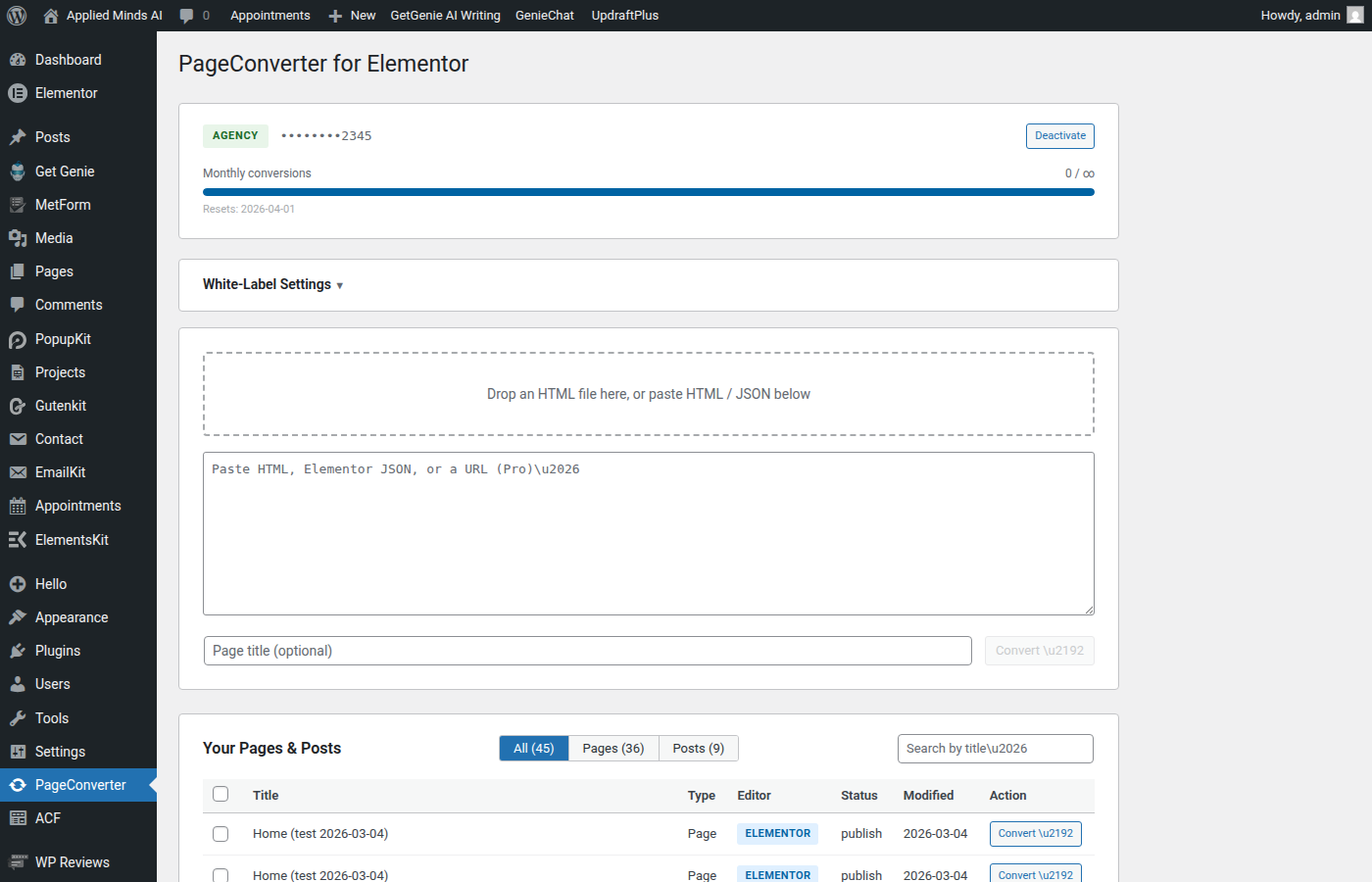
PageConverter workspace in WordPress

The engineering problem

Turn any webpage into an Elementor editable page in WordPress.

The application Sarolta builtA conversion platform that reads a source page, recovers its intent, maps it to native Elementor structure, validates the document, and returns it for human finishing work.

AI could already produce polished HTML and CSS in minutes. The harder problem was preserving that work inside a live editorial system of Elementor containers, widgets, responsive settings, templates, and WordPress data.

Conversion was treated as a translation problem rather than a file import. Each part of the source must become an appropriate editable component, retain its behaviour across breakpoints, and remain safe for future changes.


Authorize every job

Account, connected site, plan, token balance, and callback destination are verified before execution.

Normalize the source

HTML, CSS, assets, hierarchy, and responsive rules become a controlled source document.

Combine rules with model reasoning

Deterministic mapping handles repeatable structure; model assistance addresses ambiguous meaning.

Validate the signed handoff

The Elementor document is checked, recorded, and returned through an authenticated callback.

The intended outcome

More creative range. More finished work. Less rebuilding.

Designer working with both hands at an Elementor page with a highlighted section

5–15 days

The typical brief-to-completion cycle for a standard business site.

3–5 days

An assisted path that leaves more time for creative finishing work.

An editable Elementor starting point can be prepared in minutes, replacing days of manual reconstruction.

The conversion spine

Deterministic where it should be. Model-assisted where interpretation matters.

A plausible model response is not treated as a finished page. Predictable parsing and normalization are combined with semantic interpretation, then the Elementor document is validated before it reaches the connected site.

The operating model

From source page to editable handoff.

Recover the source structure

HTML, CSS, assets, hierarchy, and responsive rules become a normalized source document.

structured source

Map with context

Rules handle repeatable patterns; model assistance resolves intent that markup cannot express.

semantic mapping

Build native Elementor structure

The output is containers, widgets, and compatible document data—not one custom-code block.

editable output

Validate before delivery

Document integrity, responsive behaviour, and the return path to WordPress are checked.

safe handoff

How the system decides

Rules for structure. Models for meaning.

Predictable parsing and normalization recover the source. Model assistance is reserved for interpretation. The returned Elementor document is then validated before delivery.

Native output

Containers, headings, text, images, and layout settings remain inspectable in Elementor.

Human finishing work

Designers retain control of theme nuance, content, visual detail, review, and publishing.

WordPress
Elementor
TypeScript
Fastify
PostgreSQL
Redis
Temporal
Docker
OpenRouter
Anthropic
Gemini
DeepSeek

Designer workflow remains central

A heading stays a Heading.

The conversion target is a structured page that behaves like an Elementor page should—not a screenshot, locked import, or visual approximation hidden in generic code.

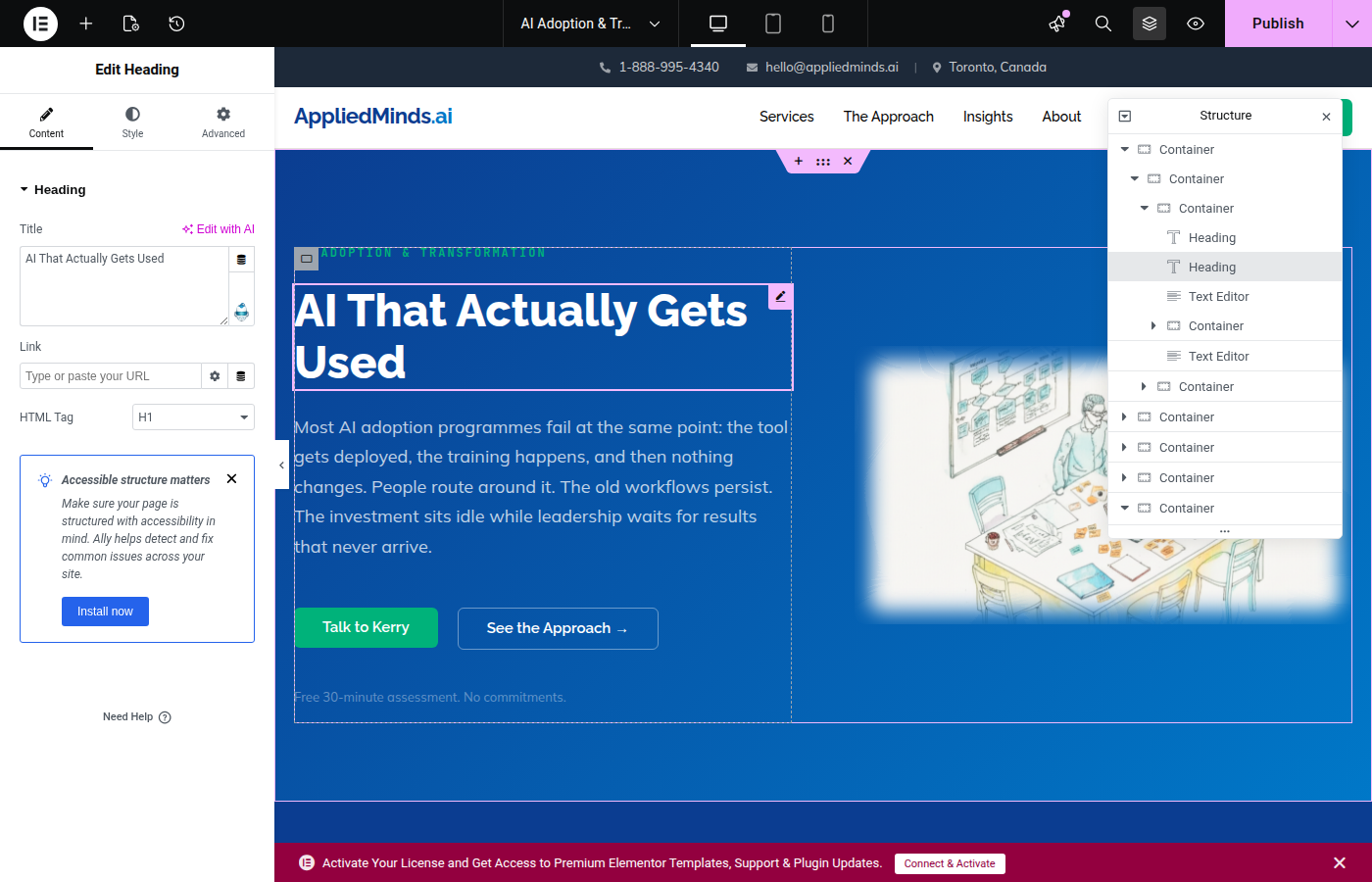
Elementor editor showing a selected Heading widget and page structure

Elementor is the destination, not an afterthought.

The delivered page keeps the editor, structure panel, and controls a designer expects to use.

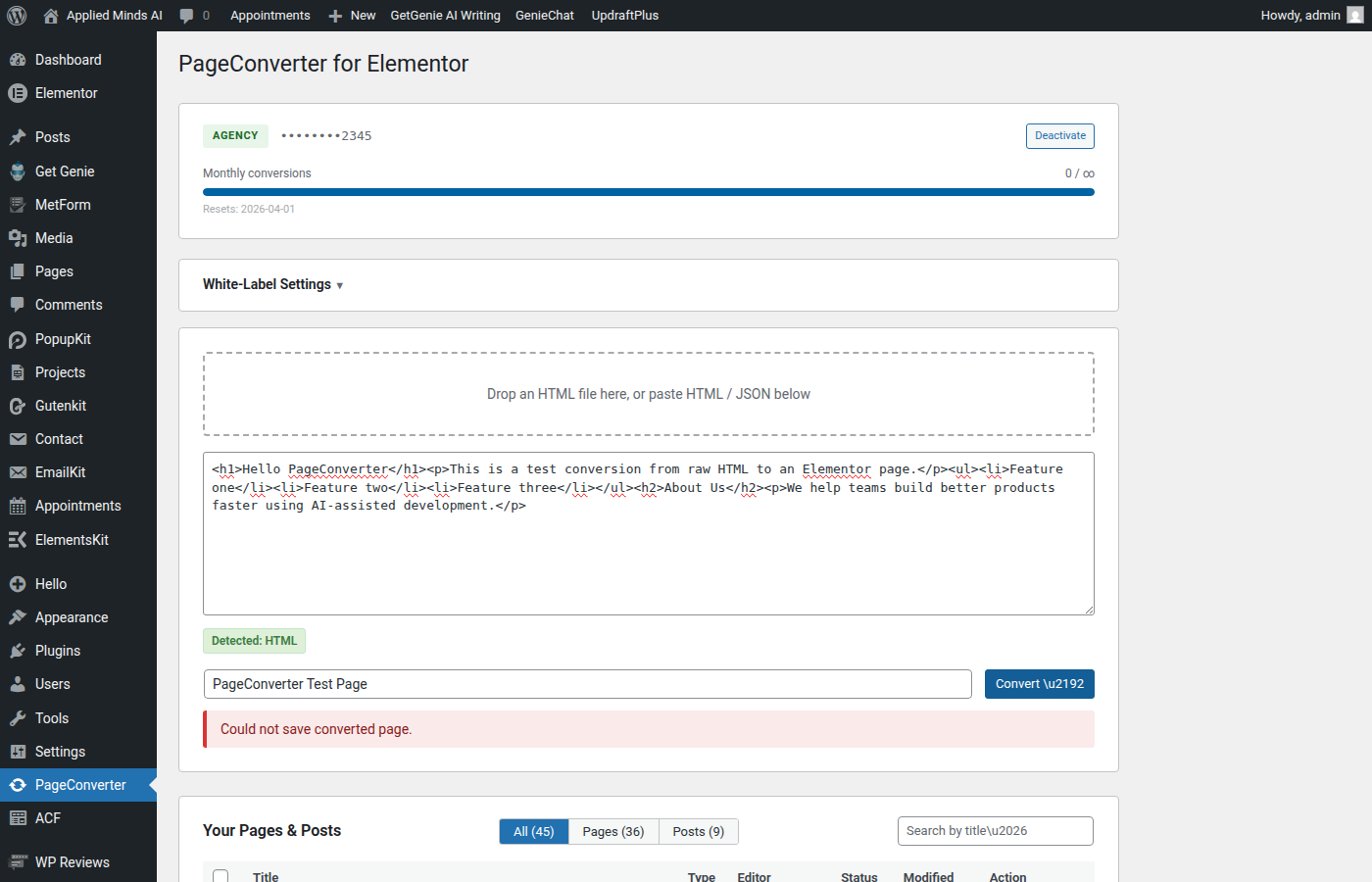
PageConverter conversion prepared for an editable handoff

Prepared before the human handoff

A conversion becomes an editable starting point in minutes, ready for finishing work.

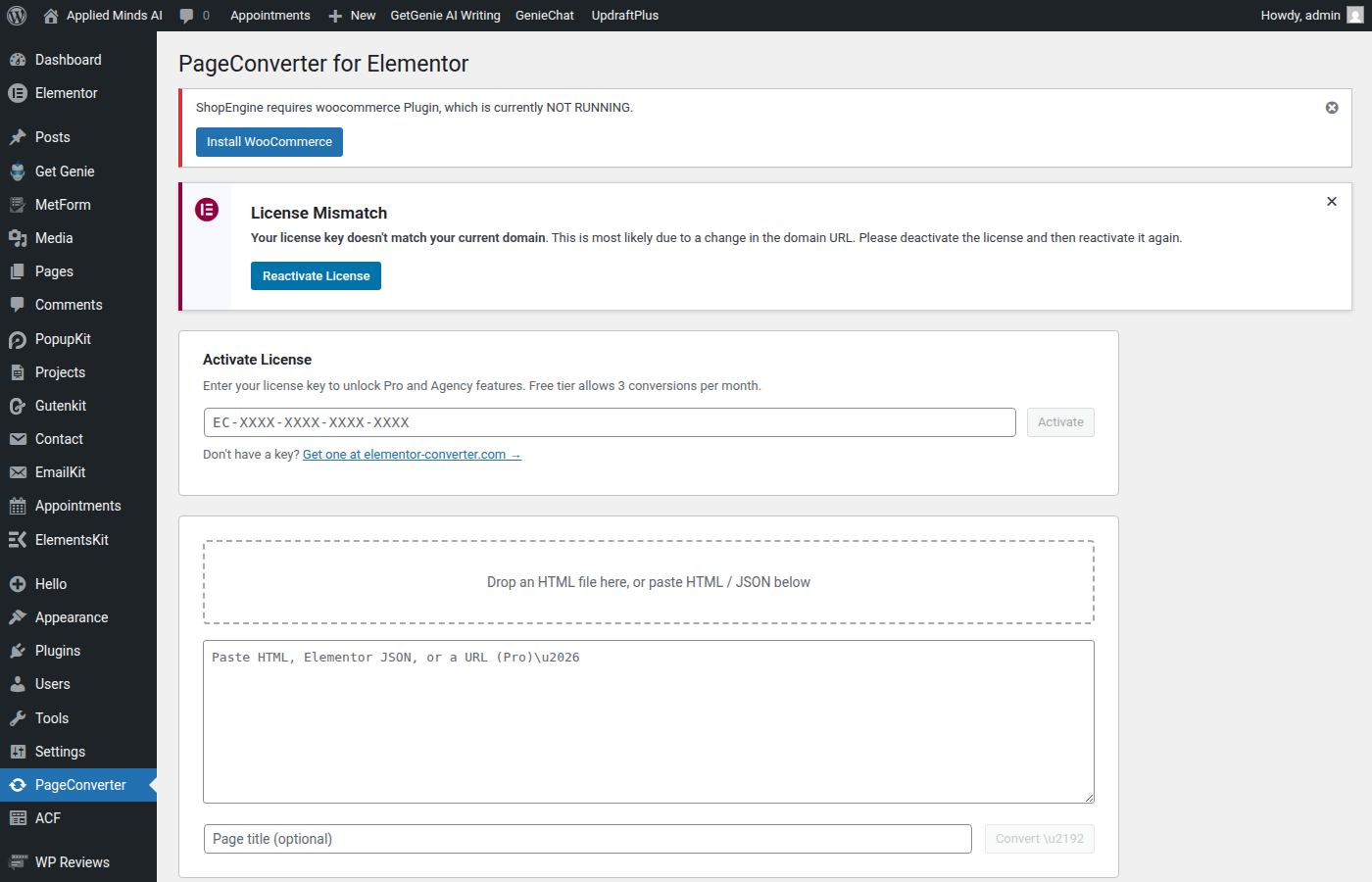
PageConverter job interface and delivery record

A user can follow the result

The workflow keeps an attributable record from source page through delivery.

Platform architecture

Explicit boundaries around a customer-site write.

Commerce, application services, conversion execution, and WordPress delivery are separated so a conversion is traceable, authorized, and safe to return to a connected customer site.

Customer & commerce

WordPress + WooCommerce

Pricing, checkout, customer accounts, and provisioning sit on the commercial site.

Application & jobs

Fastify, Postgres, Redis, Temporal

The typed API owns accounts, sites, API keys, job state, token accounting, and durable workflow direction.

Conversion & delivery

Authorized workers + WordPress plugin

Workers prepare and validate output; the customer plugin receives signed delivery and writes the Elementor document.

APIFastify services scale independently.

RecordPostgreSQL retains job and ledger truth.

WorkersCapacity follows queue depth and provider throughput.

ProvidersClaude, Gemini, Codex, and DeepSeek route at runtime, including through OpenRouter.

Zero-trust engineering discipline

Trust is NOT part of the conversion.

No caller, model response, callback, or destination is assumed safe. Every customer-site write must be authorized, scoped, validated, and evidenced.

Durable jobs

Every run has an owner and an outcome.

Each job carries its account, site, authorization state, token balance, provider choice, execution record, and terminal result.

Security boundaries

Delivery is signed, scoped, and checked.

Connection tokens, hashed API keys, HMAC callbacks, destination validation, and rate limits protect the route back to WordPress.

Evidence-driven delivery

The complete path requires evidence.

Docker provides isolated acceptance environments; installer-based delivery owns the real runtime, migrations, wiring, and plugins.

AI-assisted development lifecycle

A strict zero-trust pipeline for production application code.

Produce

Create the phase artifact against its approved boundary.

Adversarial review

Challenge completeness, ambiguity, risk, and evidence.

Remediate

Resolve accepted findings before the next gate.

1. Requirements

Define production goals, constraints, risks, ownership, and acceptance criteria.

2. Specification

Turn approved requirements into a precise, testable technical contract.

3. Tests / RED

Build failing tests that prove the required behaviour is absent.

4. Code / GREEN

Implement only against the specification and RED evidence.

5. Implementation review

Evaluate the whole system with fresh integration, security, and end-to-end evidence.

What the engineering decisions preserved

Design freedom before conversion. Real controls after it.

Have a difficult workflow step?

Bring us the part that does not fit in a prompt.

Dependable tools can be built around the systems a team already uses.